
How to Build a Quarterly Bookkeeping Review Checklist
Monthly bookkeeping keeps your books current, but a quarterly review keeps them trustworthy. This step by step guide walks through how to build a quarterly bookkeeping review checklist, with real examples and a printable checklist.
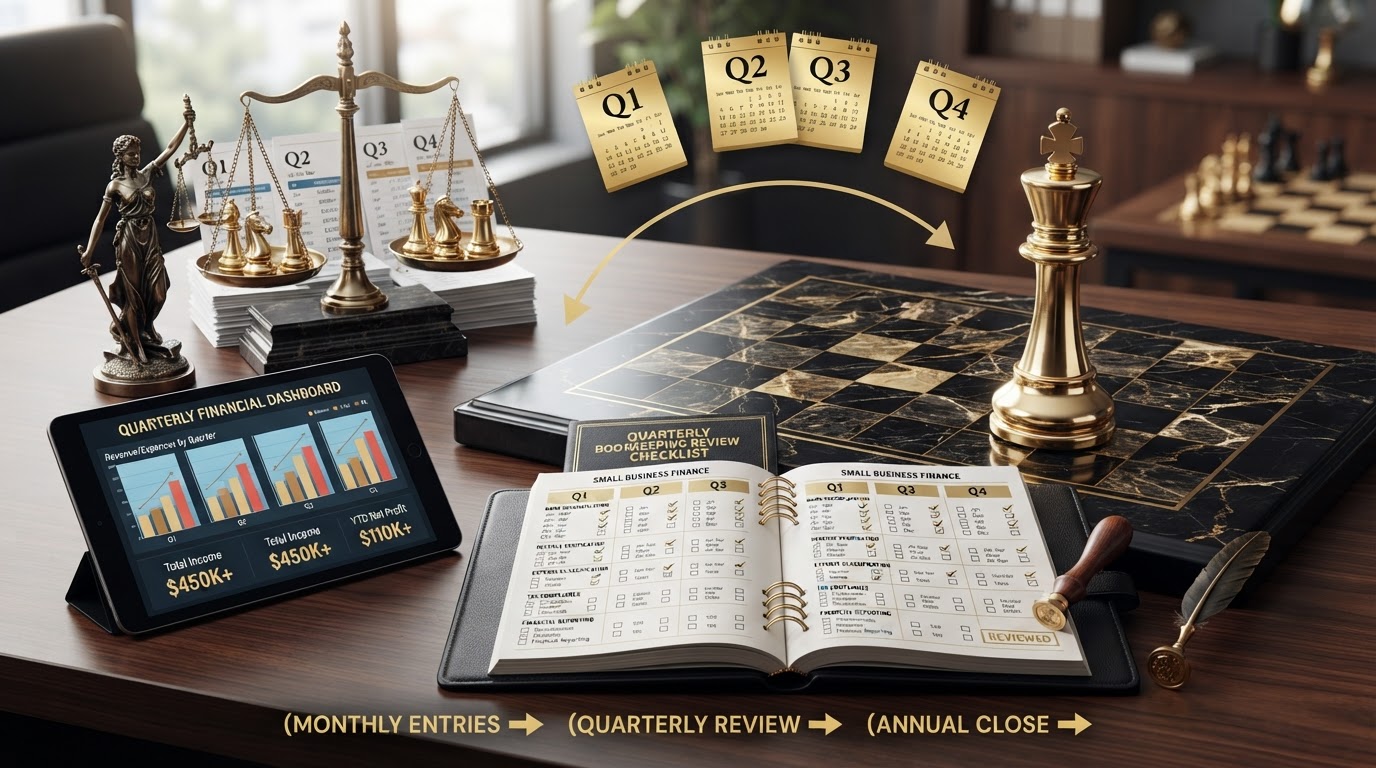
Monthly bookkeeping keeps your books current, but a quarterly bookkeeping review is what keeps them trustworthy. Every three months, you step back from the day to day entries and look at the full picture. You confirm your accounts reconcile, your reports make sense, your balances are real, and nothing has slipped through the cracks since the last quarter closed. A quarterly review catches the problems a monthly close cannot see, because some issues only become visible when you compare three months of activity side by side. A loan payment coded to the wrong account for one month is a small error. The same error repeated across a quarter is a distorted profit and loss, and a quarter is long enough for a small error to become a real problem.
This guide walks through how to build a quarterly bookkeeping review checklist step by step. It is written for small business owners who want to keep their books accurate, their reports reliable, and their financial picture clear. If your books are already behind, start with our guide on catch up bookkeeping and how to get back on track before you build a quarterly review on top of them.
How to Build a Quarterly Bookkeeping Review Checklist
Building a quarterly bookkeeping review checklist is a deliberate process, not a quick list. Work through these steps in order, one account and one category at a time, until your quarter is reviewed, documented, and closed.
1. Confirm Every Account Is Reconciled
The first item on any quarterly review is confirming every bank account, credit card, and loan account is reconciled through the end of the quarter. A quarterly review built on unreconciled accounts is a review of numbers you cannot trust. Open each account, confirm the reconciliation is complete, and confirm the ending balance matches the statement. If any account is not reconciled, stop and reconcile it before you continue. A quarterly review that skips an unreconciled account carries the error forward into the next quarter, where it becomes harder to find.
Why it matters. Reconciliation is the foundation of every review. A review built on unreconciled accounts is a review of guesses, not numbers.
Common mistake. Starting the review without confirming every account is reconciled. You review reports that include unreconciled errors and never know the numbers are wrong.
2. Review Every Unreconciled Transaction
Once your accounts are reconciled, review the unreconciled transactions that remain. These are the entries that did not match a statement, and they are the ones most likely to hide an error. Sort them by date and amount, identify any duplicates, confirm transfers are recorded on both sides, and resolve any stale checks or deposits. For a full walkthrough of this process, see our guide on how to review unreconciled transactions. Clearing your unreconciled list every quarter keeps it from growing into an unmanageable backlog.
Why it matters. Unreconciled transactions are where errors hide. Reviewing them every quarter keeps the list short and the problems small.
Common mistake. Skipping the unreconciled review because the accounts are reconciled. The unreconciled entries are the ones that did not match, and they are the ones that need attention.
3. Compare Your Quarterly Reports Side by Side
Pull your profit and loss and balance sheet for each month of the quarter and compare them side by side. Look for month to month changes that seem too large or too small, and for categories that moved in a direction you did not expect. A quarterly comparison reveals patterns a single month cannot. A utility expense that doubled in one month might be a seasonal change, or it might be a misclassified charge. Revenue that dropped in one month might be a slow month, or it might be a missing invoice. Comparing three months side by side gives you the context to tell the difference.
Why it matters. Three months side by side reveals patterns and anomalies a single month cannot. You see the trend instead of a snapshot.
Common mistake. Reviewing only the current month and missing a trend that started two months ago. A single month tells you what happened, not what is happening.
4. Verify Your Revenue and Expense Categories
Walk through your chart of accounts and confirm every revenue and expense category is being used correctly. Look for transactions that landed in the wrong category, categories with only one or two entries that might belong elsewhere, and categories that grew unexpectedly. A quarterly review is the right time to reclassify an expense that was coded wrong for a month or two, because the error is recent enough to trace and the quarter is the natural unit for a correction. Verifying categories every quarter keeps your reports accurate and your year end cleanup small.
Why it matters. Categories drift over time. A quarterly check keeps them accurate before the drift becomes a year long problem.
Common mistake. Waiting until year end to review categories. By then, a misclassified expense has been sitting in the wrong place for months and is harder to trace.
5. Review Your Accounts Receivable Aging
Pull your accounts receivable aging report and review every outstanding invoice. Identify which invoices are past due, how far past due they are, and whether any need a follow up or a write off. A quarterly review keeps your receivables current and your expectations realistic. An invoice that has been outstanding for 90 days is less likely to be collected than one that is 30 days old, and your books should reflect that reality. Reviewing receivables every quarter means you catch stale invoices before they become uncollectible, and your revenue reflects what you actually expect to receive.
Why it matters. Receivables age quickly. A quarterly review keeps your aging current and your revenue expectations realistic.
Common mistake. Ignoring the aging report until year end. By then, a stale invoice has been sitting on your books for months, inflating your revenue and your expectations.
6. Review Your Accounts Payable Aging
Pull your accounts payable aging report and confirm every outstanding bill is accurate and expected. Look for bills you have already paid that are still showing as unpaid, bills you do not recognize, and bills that are past due. A quarterly review keeps your payables accurate and your vendor relationships healthy. A bill that was paid but never cleared from your payables distorts your expense totals and your cash balance. Reviewing payables every quarter means you catch the error while the payment is recent enough to trace, and your books reflect what you actually owe.
Why it matters. Payables drift when bills are paid but not cleared. A quarterly review keeps your payables accurate and your balances real.
Common mistake. Trusting your payables list without reviewing it. A paid bill that was never cleared sits on your books for months, distorting your totals.
7. Confirm Loan and Fixed Asset Balances
Review every loan account and confirm the balance matches the lender statement. Confirm each loan payment was split correctly between principal and interest, because a misapplied payment distorts both your loan balance and your interest expense. Review your fixed asset register and confirm any asset purchases or disposals from the quarter are recorded. A quarterly review keeps your balance sheet accurate, because your loan balances and asset values are the numbers a lender or an investor will question first. Confirming them every quarter means your balance sheet is ready when you need it, not rebuilt when you need it.
Why it matters. Loan and asset balances are the most questioned numbers on a balance sheet. Confirming them quarterly keeps them ready.
Common mistake. Ignoring loan balances until you need them. By then, a misapplied payment has distorted your balance for months and the fix takes hours.
8. Review Owner Contributions and Withdrawals
Review every owner contribution and withdrawal from the quarter and confirm each one is classified correctly. An owner contribution recorded as revenue inflates your income. An owner withdrawal recorded as an expense understates your profit. A personal charge coded into the business distorts your expense categories. A quarterly review keeps the line between business and personal clear, because the longer a misclassified owner transaction sits, the harder it is to trace. Reviewing owner transactions every quarter keeps your reports accurate and your personal and business finances separate.
Why it matters. Owner transactions are the most commonly misclassified entries. A quarterly review keeps the line between business and personal clear.
Common mistake. Letting owner transactions accumulate without review. By year end, you cannot tell which were contributions, which were withdrawals, and which were personal charges.
9. Check Your Sales Tax Liability Accounts
If you collect sales tax, review your sales tax liability account every quarter and confirm the balance matches what you owe. Sales tax you collected belongs to the taxing authority, not to your business, and your liability account should reflect the amount you have collected but not yet remitted. A quarterly review catches a discrepancy while the quarter is recent enough to trace, because a sales tax liability that drifts from the actual amount owed creates a problem that compounds over time. Confirming the balance every quarter keeps your liability accurate and your remittance correct.
Why it matters. Sales tax liabilities drift when returns and payments are not recorded accurately. A quarterly check keeps the balance matched to what you owe.
Common mistake. Trusting the sales tax liability balance without reviewing it. A small discrepancy grows over quarters until the amount on your books no longer matches the amount you actually owe.
10. Review Payroll Liabilities and Deductions
Review every payroll liability account and confirm the balance matches your payroll records. Check that payroll tax deposits were recorded, that deductions were remitted or accrued correctly, and that any benefits or garnishments are tracked accurately. Payroll liabilities are time sensitive, and a quarterly review keeps them current. A payroll tax deposit that was paid but not recorded leaves a liability on your books that no longer exists. A deduction that was withheld but not remitted leaves a liability that does. Reviewing payroll liabilities every quarter keeps your books matched to your payroll and your obligations clear.
Why it matters. Payroll liabilities are time sensitive and prone to recording gaps. A quarterly review keeps them matched to your actual obligations.
Common mistake. Skipping payroll liabilities because payroll runs on its own. A deposit that was paid but not recorded leaves a phantom liability that distorts your balance sheet.
11. Verify Each Monthly Close Was Complete
Confirm that each month within the quarter was fully closed. A monthly close means your accounts were reconciled, your reports were reviewed, and your entries were finalized. A quarterly review built on months that were never closed is a review of months that may still contain errors. For the full monthly routine, see our guide on how to complete a monthly bookkeeping close. Verifying each monthly close before the quarterly review means your review starts from a solid foundation instead of chasing errors that should have been caught a month ago.
Why it matters. A quarterly review is only as good as the monthly closes beneath it. Verifying each close means your review starts from solid ground.
Common mistake. Running a quarterly review without confirming the monthly closes. You review months that still contain unreconciled accounts and unreviewed reports.
12. Document and File the Quarter
Once the review is complete, document what you found, what you corrected, and what still needs attention. Save your quarterly reports, your reconciliation summaries, and your review notes in a quarterly folder so the quarter is closed and archived. Documentation means the next person who looks at your books, whether it is your bookkeeper, your accountant, or you next quarter, can see what was reviewed and what was resolved. A documented quarter is a closed quarter. An undocumented quarter is a set of numbers someone has to review again because the decisions are invisible.
Why it matters. Documentation closes the quarter and makes your review repeatable. Without it, the next person has to retrace every decision you made.
Common mistake. Finishing the review without documenting it. Next quarter, no one can tell what was reviewed, what was corrected, or what was left open.
13. Schedule the Next Quarterly Review
Set the date for the next quarterly review before this one is forgotten. A quarterly review only works if it happens every quarter, and the easiest way to make that happen is to schedule it in advance. Block the time on your calendar, set a reminder, and treat it as a nonnegotiable part of running your business. A scheduled review happens. An unscheduled review gets postponed until the backlog is unmanageable. Scheduling the next review while this one is fresh means the habit stays intact and the next quarter starts on time.
Why it matters. A scheduled review happens. An unscheduled review gets postponed until the backlog is unmanageable and the review takes days instead of hours.
Common mistake. Finishing the review without scheduling the next one. The quarter ends, the review is forgotten, and the next review starts with a backlog.
Two Real Small Business Examples
Example: A landscaping company reviewing its first quarter. A landscaping owner ran her bookkeeping month to month but never reviewed the quarter as a whole. When she compared her three monthly profit and loss reports side by side for the first time, she noticed her equipment repair expense had climbed each month. She traced the increase to a single vendor whose invoices were being coded to repairs instead of equipment maintenance. She reclassified the entries, reviewed her accounts receivable aging, and found two invoices from the first month of the quarter that were past due. She followed up on both, wrote off one that was uncollectible, and documented the entire review. Her next quarterly review took half the time because the first quarter was clean and the pattern was familiar.
Example: A consulting firm catching a payroll liability gap. A consulting firm owner ran his quarterly review and checked his payroll liability accounts. He noticed his payroll tax liability balance was higher than the amount he actually owed. He traced the discrepancy to a payroll tax deposit that had been paid but never recorded in his books, because the payment had been processed outside his accounting software. He recorded the deposit, confirmed the liability balance matched his actual obligation, and documented the fix. He also reviewed his owner withdrawal account and found a personal charge that had been coded into business expenses. He reclassified it, and his quarterly profit and loss reflected his true business performance for the first time.
Printable Quarterly Bookkeeping Review Checklist
Use this checklist to run your quarterly bookkeeping review. Print it, save it, or share it with whoever handles your books.
- Confirm every bank, credit card, and loan account is reconciled through quarter end.
- Review every unreconciled transaction and resolve duplicates, missing entries, and stale items.
- Pull your profit and loss and balance sheet for each month and compare them side by side.
- Verify every revenue and expense category is being used correctly.
- Review your accounts receivable aging and follow up on past due invoices.
- Review your accounts payable aging and confirm every outstanding bill is accurate.
- Confirm every loan balance matches the lender statement and payments are split correctly.
- Review owner contributions and withdrawals for correct classification.
- Check your sales tax liability account and confirm the balance matches what you owe.
- Review payroll liability accounts and confirm deposits and deductions are recorded.
- Verify each monthly close within the quarter was complete.
- Document what you reviewed, what you corrected, and what still needs attention.
- File your quarterly reports and review notes in a quarterly folder.
- Schedule the next quarterly review before this one is forgotten.
Getting Started
A quarterly bookkeeping review is the difference between books you trust and books you have to guess about. Every account you reconcile, every report you compare, and every category you verify is a number you can rely on. The routine is the same every quarter: confirm your reconciliations, review your unreconciled transactions, compare your reports side by side, verify your categories and balances, review your receivables and payables, and document the review. Build it into your calendar and the work stays manageable. Skip it and your errors compound, your reports drift, and the next review takes days instead of hours. If your books have not been reviewed in a quarter or more, the best next step is a conversation about where they stand today.
Ready to build a quarterly review into your bookkeeping? Explore our bookkeeping services and let us run your quarterly reviews, keep your books accurate, and keep your reports reliable. We handle bookkeeping and payroll. We do not prepare income tax returns, offer tax planning, or perform audits, but we keep your books clean every quarter so you can run your business with confidence.
Frequently Asked Questions
What is a quarterly bookkeeping review?
A quarterly bookkeeping review is a structured review of your books every three months. It goes beyond the monthly close by comparing three months of activity side by side, confirming every account reconciles, verifying your reports make sense, and catching errors that a single month cannot reveal. A quarterly review keeps your books accurate, your reports reliable, and your financial picture clear, because some problems only become visible when you look at a full quarter instead of a single month.
How is a quarterly review different from a monthly close?
A monthly close reconciles your accounts and finalizes your entries for a single month. A quarterly review steps back and looks at three months together. It compares your reports side by side, reviews your receivables and payables aging, confirms your loan and asset balances, and catches patterns and errors that a monthly close cannot see. A monthly close keeps your books current. A quarterly review keeps them trustworthy. Both are necessary, and a quarterly review is built on top of complete monthly closes.
What should I include in a quarterly bookkeeping review checklist?
A quarterly review checklist should confirm every account is reconciled, review unreconciled transactions, compare monthly reports side by side, verify revenue and expense categories, review accounts receivable and payable aging, confirm loan and fixed asset balances, review owner contributions and withdrawals, check sales tax and payroll liabilities, verify each monthly close was complete, document the review, and schedule the next one. The checklist keeps the review thorough and repeatable every quarter.
How often should I run a quarterly bookkeeping review?
Run a quarterly bookkeeping review once every three months, at the end of each fiscal quarter. Schedule the next review before the current one is forgotten, and treat it as a nonnegotiable part of running your business. A review that happens every quarter keeps your books accurate and your backlog small. A review that gets postponed grows into a backlog that takes days instead of hours, because the errors have more time to compound.
Why should I compare my monthly reports side by side?
Comparing three monthly reports side by side reveals patterns and anomalies a single month cannot. A utility expense that doubled in one month might be seasonal, or it might be a misclassified charge. Revenue that dropped in one month might be a slow month, or it might be a missing invoice. Three months of context lets you tell the difference between a normal variation and an error, and it lets you catch a trend before it becomes a problem.
Can a quarterly review help me prepare for year end?
Yes. A quarterly review every three months means your year end review is small, because you have already caught and corrected errors throughout the year. Your accounts are reconciled, your categories are accurate, and your balances are confirmed. Instead of a year end scramble, you close the fourth quarter the same way you closed the first three. For the full year end routine, see our guide on how to prepare your books for year end, which builds on the quarterly reviews you have already completed.
Can Chess Bookkeeping & Payroll help me with a quarterly bookkeeping review?
Yes. A quarterly bookkeeping review is a core part of our bookkeeping service. We reconcile your accounts, review your unreconciled transactions, compare your reports, verify your categories and balances, review your receivables and payables, check your liabilities, and document the entire review so your books stay accurate and your reports stay reliable. We handle bookkeeping and payroll. We do not prepare income tax returns, offer tax planning, or perform audits, but we keep your books clean every quarter so you can run your business with confidence.
Need help getting your books in order?
We focus exclusively on bookkeeping and payroll. Let's talk about where your books stand today.
Get StartedReady to simplify your books and payroll?
Schedule a consultation and let's talk about how precise bookkeeping and reliable payroll can give your business the clarity it deserves.