
How to Review Unreconciled Transactions
Unreconciled transactions are the gap between your books and your bank. This step by step guide walks through how to review them, with real examples and a printable checklist.
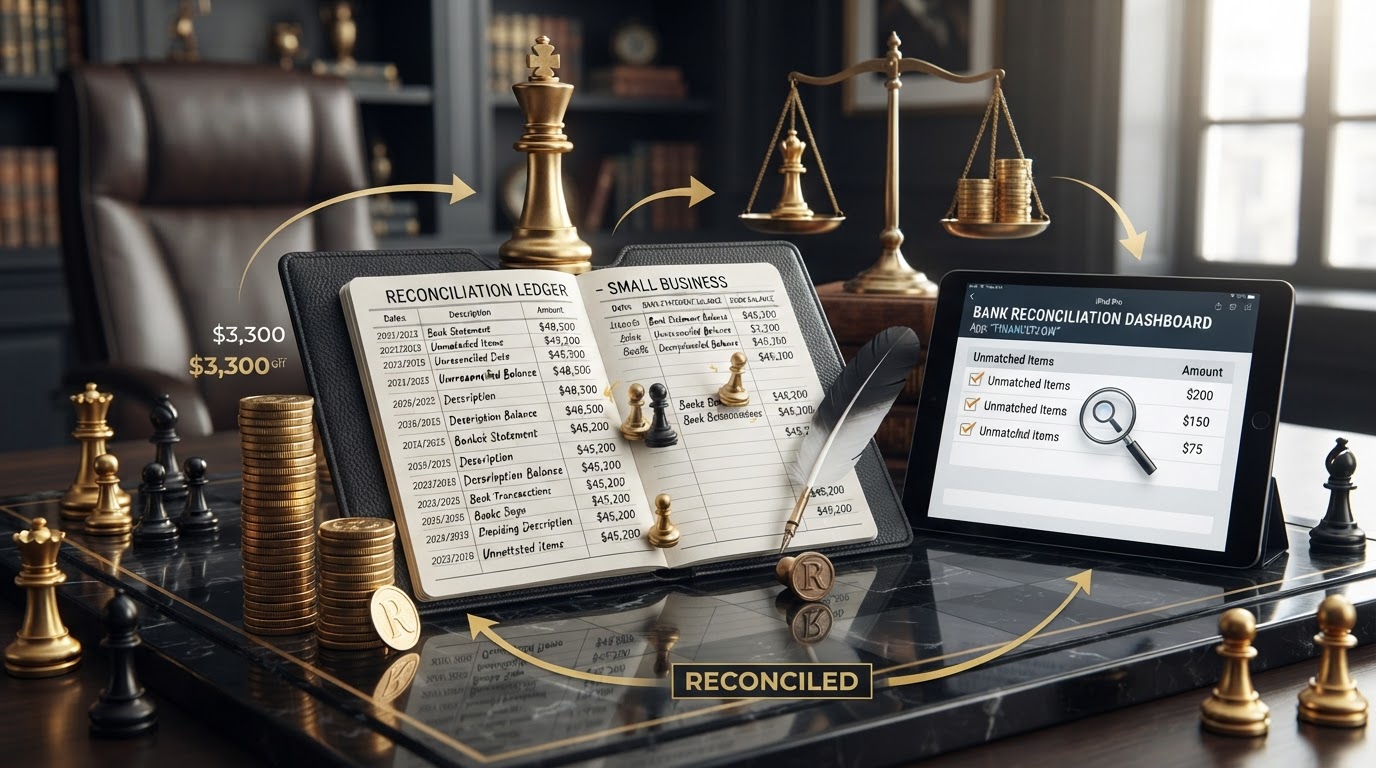
Unreconciled transactions are the entries in your books that have not yet been matched to a bank or credit card statement. A few of them are normal at any given moment, because transactions clear the bank on their own schedule. But when unreconciled transactions pile up month after month, they become the gap between what your books say you have and what your bank says you have. That gap is where errors hide, where duplicates live, and where missing entries go unnoticed until they distort a report or stall a loan application. Reviewing your unreconciled transactions is not the same as reconciling your accounts. It is the deliberate step of looking at every unmatched entry, deciding whether it belongs, and clearing it before it becomes a problem.
This guide walks through how to review unreconciled transactions step by step. It is written for small business owners who want to keep their books accurate and their balances trustworthy. If your books are already behind, start with our guide on catch up bookkeeping and how to get back on track before you review your unreconciled transactions.
How to Review Unreconciled Transactions
Reviewing your unreconciled transactions is a methodical process, not a quick glance. Work through these steps in order, one entry and one account at a time, until your unreconciled list holds only the transactions that are simply waiting to clear.
1. Understand What Unreconciled Means
Before you review a single entry, understand what unreconciled means in your accounting software. An unreconciled transaction is one that has been entered into your books but has not yet been matched to a cleared transaction on your bank or credit card statement. It is not necessarily wrong. A check you wrote yesterday is unreconciled because it has not cleared the bank yet. A bank fee you recorded is unreconciled because the statement has not arrived. The goal of a review is not to force every transaction to reconcile. It is to confirm that every unreconciled entry is legitimate, expected, and on its way to clearing, and that none of them are errors, duplicates, or missing records hiding in the gap.
Why it matters. Understanding the difference between a normal unreconciled entry and a problem one keeps you from chasing transactions that are simply waiting to clear.
Common mistake. Treating every unreconciled transaction as an error. You spend hours investigating a check that simply has not cleared the bank yet.
2. Pull Your Unreconciled Transactions Report
Start every review with the full list. Open your accounting software, pull the unreconciled transactions report for each bank and credit card account, and export it so you can work through it without losing your place. The report shows every entry that has not yet been matched to a statement, along with its date, amount, payee, and category. Pulling the full list first means you see the scope of the review before you start, so you can spot patterns, like a single vendor with a dozen unmatched entries, or a month where nothing was reconciled at all. A complete list is the difference between a thorough review and a guessing game.
Why it matters. A complete report shows you the full scope before you start. Reviewing entries one at a time from memory means you miss the patterns.
Common mistake. Opening your accounting software and clicking through accounts one at a time without a list. You lose track of what you reviewed and what you skipped.
3. Check Your Reconciliation Status First
Before you review a single unreconciled entry, confirm your accounts are reconciled through the most recent statement. If your last reconciliation was three months ago, the unreconciled list is going to be long for a reason that has nothing to do with errors. Run the reconciliation first, match what clears, and then review what remains. For a full walkthrough of the reconciliation process itself, see our guide on how to reconcile a business bank account step by step. Reviewing unreconciled transactions only makes sense after your reconciliations are current.
Why it matters. Reconciling first clears the transactions that simply needed matching. What remains is the list that actually needs review.
Common mistake. Reviewing an unreconciled list that is long only because you have not reconciled in months. You investigate entries that would have cleared on their own.
4. Sort by Date and Amount
Once you have the list, sort it two ways. Sort by date first so you can see the oldest unreconciled entries, because the oldest ones are the most likely to be problems. A transaction that has been unreconciled for six months is either waiting to clear or it is an error, and six months is long enough to know which. Then sort by amount, because the largest unreconciled entries carry the most risk. A ten dollar unreconciled transaction might be a rounding difference. A ten thousand dollar one is a question you need to answer before it distorts your balance. Sorting both ways means you review the oldest and the largest first, which is where the real issues live.
Why it matters. The oldest and largest unreconciled entries carry the most risk. Sorting by date and amount puts them in front of you first.
Common mistake. Reviewing the list in whatever order your software displays it. You spend an hour on recent small entries and never reach the old large one that actually matters.
5. Identify Duplicate Transactions
Duplicates are the most common error in an unreconciled list, and they are the easiest to spot. Look for two entries with the same date, the same amount, and the same payee. A duplicate happens when a transaction is entered twice, often because of a sync error, a manual reentry, or a bank feed that pulled the same transaction twice. Each duplicate inflates a category and throws off your totals. When you find one, confirm it is a true duplicate by checking the bank statement, then delete or void the extra entry. Clearing duplicates is the fastest way to shrink an unreconciled list and restore trust in your balances.
Why it matters. Duplicates inflate your expenses and distort your balances. Clearing them is the fastest way to make your unreconciled list accurate.
Common mistake. Leaving a duplicate because you are not sure which one to delete. You keep both, and your expenses are double what they should be.
6. Check for Missing Entries on the Other Side
An unreconciled transaction in your books can mean a transaction is missing from your books, not just that one is waiting to clear. Compare your unreconciled list to your bank statement and look for bank transactions that have no matching entry in your books. A bank fee, an interest charge, or a transfer that you did not record shows up on the statement but not in your unreconciled list, because it was never entered. Finding a missing entry means adding it to your books so it can be reconciled. The review is not just about what is in your unreconciled list. It is about what should be there and is not.
Why it matters. A missing entry is an error that hides by its absence. Comparing both sides of the reconciliation catches what your unreconciled list cannot.
Common mistake. Reviewing only the entries in your unreconciled list and never comparing to the bank statement. You miss the transactions that were never entered at all.
7. Verify Every Old Unreconciled Entry
Any unreconciled transaction older than 60 days deserves a closer look. A check that has not cleared in two months may have been lost, stolen, or voided without updating your books. A deposit that has not cleared may have been returned or rejected. A credit card charge that has not matched may have been recorded to the wrong account. For each old entry, trace it to the bank statement, confirm it has not cleared, and decide whether it is still valid. If a check is stale, void it. If a deposit was returned, reverse it. Old unreconciled entries are the ones most likely to be errors, so they are the ones most worth verifying.
Why it matters. Old unreconciled entries are the most likely to be errors. A transaction that has not cleared in months is a question you need to answer.
Common mistake. Assuming an old unreconciled entry is just slow to clear. A six month old check is not waiting. It is either lost, voided, or wrong.
8. Review Misclassified Transactions
An unreconciled transaction that is in the wrong category is still unreconciled, and it distorts your reports even after it clears. Look at the category on each unreconciled entry and confirm it is correct. A loan payment recorded as an operating expense, a personal charge coded into the business, or a software subscription recorded as office supplies all show up in the wrong place on your profit and loss. Correcting the category before the transaction clears means your reports are accurate from the moment the entry reconciles. A misclassified transaction that clears without correction is a report error you have to find later, when it is harder to trace.
Why it matters. Correcting a category before a transaction clears means your reports are accurate from the start. Correcting it later means retracing a cleared entry.
Common mistake. Letting a misclassified transaction clear because you will fix it later. Later means it is buried in a reconciled month, and the fix is harder to find.
9. Confirm Transfers Between Accounts
Transfers between your own accounts are a common source of unreconciled confusion. When you move money from checking to savings, the transfer shows up as an outgoing transaction in one account and an incoming transaction in the other. If only one side is entered, or if the two sides are recorded on different dates, the entries stay unreconciled because they do not match a single statement transaction. Review every transfer in your unreconciled list and confirm both sides are recorded, on the correct dates, in the correct accounts. A transfer that is entered on only one side looks like a missing transaction on the other, and it stays unreconciled until you fix it.
Why it matters. Transfers need both sides entered correctly to clear. A one sided transfer stays unreconciled and distorts both account balances.
Common mistake. Recording a transfer on only one side because you forgot the other account. The entry stays unreconciled, and both balances are off.
10. Resolve Stale Checks and Deposits
Checks and deposits that have not cleared after a reasonable period need a decision, not a wait. A check that is months old may never be cashed, and leaving it unreconciled keeps your balance artificially low. A deposit that was returned by the bank needs to be reversed so your books match reality. For each stale item, confirm the status with the bank, then void the check or reverse the deposit in your books so the entry clears the unreconciled list. Resolving stale items keeps your unreconciled list honest, because an entry that will never clear should not sit in your books forever waiting for a reconciliation that will not happen.
Why it matters. A stale check or returned deposit will never clear on its own. Resolving it keeps your balance and your unreconciled list accurate.
Common mistake. Leaving a stale check unreconciled for a year because you hope it will clear. It keeps your balance low and your unreconciled list cluttered.
11. Document Each Review Decision
Every time you resolve an unreconciled transaction, note what you did and why. If you voided a stale check, note the date and the reason. If you deleted a duplicate, note which entry you kept and which you removed. If you added a missing entry, note where you found it on the bank statement. Documentation means the next person who looks at your books, whether it is your bookkeeper, your accountant, or you in six months, can follow your reasoning. A reviewed unreconciled list with notes is a trustworthy record. A reviewed list with no notes is a list someone has to review again because the decisions are invisible.
Why it matters. Documentation makes your review repeatable and auditable. Without notes, the next person has to retrace every decision you made.
Common mistake. Clearing unreconciled entries without noting why. Six months later, no one can tell whether a voided check was stale or a mistake.
12. Schedule a Monthly Unreconciled Review
A single review clears your unreconciled list once. A monthly review keeps it clear. Set a recurring time after your monthly reconciliation to review every unreconciled transaction, resolve the ones that need action, and confirm the rest are simply waiting to clear. A monthly review means your unreconciled list never grows beyond a single month, which makes each review quick and each problem small. For the full monthly routine, see our guide on how to complete a monthly bookkeeping close, which includes the unreconciled review as part of the close.
Why it matters. A monthly review keeps your unreconciled list short and your problems small. Waiting means a long list and large problems.
Common mistake. Reviewing unreconciled transactions only when something breaks. By then the list is long, the errors are old, and the review takes days instead of minutes.
Two Real Small Business Examples
Example: A landscaping company with a long unreconciled list. A landscaping owner noticed his checking balance never matched his bank statement, and his unreconciled list had grown to over 40 entries. He pulled the report, sorted by date, and found a check from eight months ago that had never been cashed, three duplicate entries from a bank feed sync error, and a transfer to his savings account that was recorded on only one side. He voided the stale check, deleted the duplicates, entered the missing side of the transfer, and documented each decision. His unreconciled list dropped to four entries, all of them recent transactions simply waiting to clear, and his balance matched his bank for the first time in months.
Example: A consulting firm catching a missing bank fee. A consulting firm owner reviewed her unreconciled credit card list and noticed it was shorter than she expected. She compared the list to her credit card statement and found a monthly service fee that had never been entered into her books, because the bank feed had missed it. The fee had been clearing the statement for three months without a matching entry, so her credit card balance in her books was higher than her actual balance by the full amount. She added the missing entries for each month, reconciled them, and documented the fix. Her next unreconciled review took minutes because the list was current and the pattern was familiar.
Printable Unreconciled Transactions Review Checklist
Use this checklist to review your unreconciled transactions every month. Print it, save it, or share it with whoever handles your books.
- Understand the difference between a normal unreconciled entry and a problem one.
- Pull the full unreconciled transactions report for every bank and credit card account.
- Confirm your accounts are reconciled through the most recent statement first.
- Sort the unreconciled list by date to find the oldest entries.
- Sort the unreconciled list by amount to find the largest entries.
- Identify and remove duplicate transactions.
- Compare your list to your bank statement to find missing entries.
- Verify every unreconciled entry older than 60 days.
- Review each entry for a misclassified category.
- Confirm transfers between accounts are recorded on both sides.
- Resolve stale checks and returned deposits.
- Document each review decision and what you did.
- Schedule a monthly unreconciled review after every reconciliation.
Getting Started
Reviewing your unreconciled transactions is the difference between books you trust and books you have to guess about. Every entry you verify, every duplicate you remove, and every stale check you void is a balance that matches the bank and a report you can rely on. The routine is the same every month: reconcile your accounts, pull your unreconciled list, review the oldest and largest entries first, resolve the errors, and document each decision. Build it into your monthly close and the work stays manageable. Skip it and your unreconciled list grows, your balances drift, and the next review takes days instead of minutes. If your unreconciled list has grown beyond a month, the best next step is a conversation about where your books stand today.
Ready to clear your unreconciled transactions? Explore our bookkeeping services and let us review your unreconciled entries, resolve the errors, and keep your balances matched to your bank. We handle bookkeeping and payroll. We do not prepare income tax returns, offer tax planning, or perform audits, but we keep your books accurate and your reports trustworthy so you can run your business with confidence.
Frequently Asked Questions
What is an unreconciled transaction?
An unreconciled transaction is an entry in your books that has not yet been matched to a cleared transaction on your bank or credit card statement. It is not necessarily an error. A check you wrote yesterday is unreconciled because it has not cleared the bank yet. The goal of reviewing unreconciled transactions is to confirm that every unmatched entry is legitimate, expected, and on its way to clearing, and that none of them are errors, duplicates, or missing records hiding in the gap.
How often should I review my unreconciled transactions?
Review your unreconciled transactions once a month, right after you reconcile your accounts. A monthly review keeps your unreconciled list short, because it never grows beyond a single month, and it keeps each problem small. Waiting longer means a longer list, older entries that are harder to trace, and a review that takes days instead of minutes. Build the review into your monthly close so it becomes a habit instead of a scramble.
What is the difference between unreconciled and unreconciled due to an error?
Every unreconciled transaction is either waiting to clear or it is an error. A check waiting to be cashed is unreconciled and normal. A duplicate entry, a missing transaction, a misclassified charge, or a one sided transfer is unreconciled because of an error. The review is the process of telling the difference, so you can let the normal ones clear and fix the errors before they distort your balances or your reports.
Why does my unreconciled list keep growing?
An unreconciled list grows when you enter transactions but do not reconcile your accounts, or when you reconcile but do not review what remains. It also grows from duplicates, missing entries, and one sided transfers that never match a statement. Reconcile your accounts first to clear what can clear, then review what remains to resolve the errors. A monthly review keeps the list from growing in the first place.
What should I do with a check that has not cleared in months?
A check that has not cleared after a reasonable period needs a decision. Confirm with your bank whether it has been cashed, returned, or is still outstanding. If it is stale and will never be cashed, void it in your books so the entry clears your unreconciled list and your balance is accurate. Document the void and the reason. Leaving a stale check unreconciled keeps your balance artificially low and your list cluttered.
Can unreconciled transactions affect my financial reports?
Yes. Unreconciled transactions are already in your books, so they appear on your profit and loss and balance sheet even before they clear the bank. A duplicate inflates an expense category. A misclassified transaction distorts a report line. A missing entry understates a balance. Reviewing your unreconciled transactions keeps your reports accurate, because you catch the errors before they flow into the numbers you rely on.
Can Chess Bookkeeping & Payroll help me review my unreconciled transactions?
Yes. Reviewing and resolving unreconciled transactions is a core part of our bookkeeping service. We pull your unreconciled reports, identify duplicates and missing entries, verify old transactions, correct misclassifications, resolve stale checks, and document every decision so your books stay accurate and your balances match your bank. We handle bookkeeping and payroll. We do not prepare income tax returns, offer tax planning, or perform audits, but we keep your books reconciled and your reports trustworthy so you can run your business with confidence.
Need help getting your books in order?
We focus exclusively on bookkeeping and payroll. Let's talk about where your books stand today.
Get StartedReady to simplify your books and payroll?
Schedule a consultation and let's talk about how precise bookkeeping and reliable payroll can give your business the clarity it deserves.