
Online Bookkeeping Services vs. Local Bookkeepers
Online bookkeeping services and local bookkeepers both keep your books accurate, but they differ in access, communication, and how they fit your workflow. This guide compares both options so you can choose the right fit for your small business.
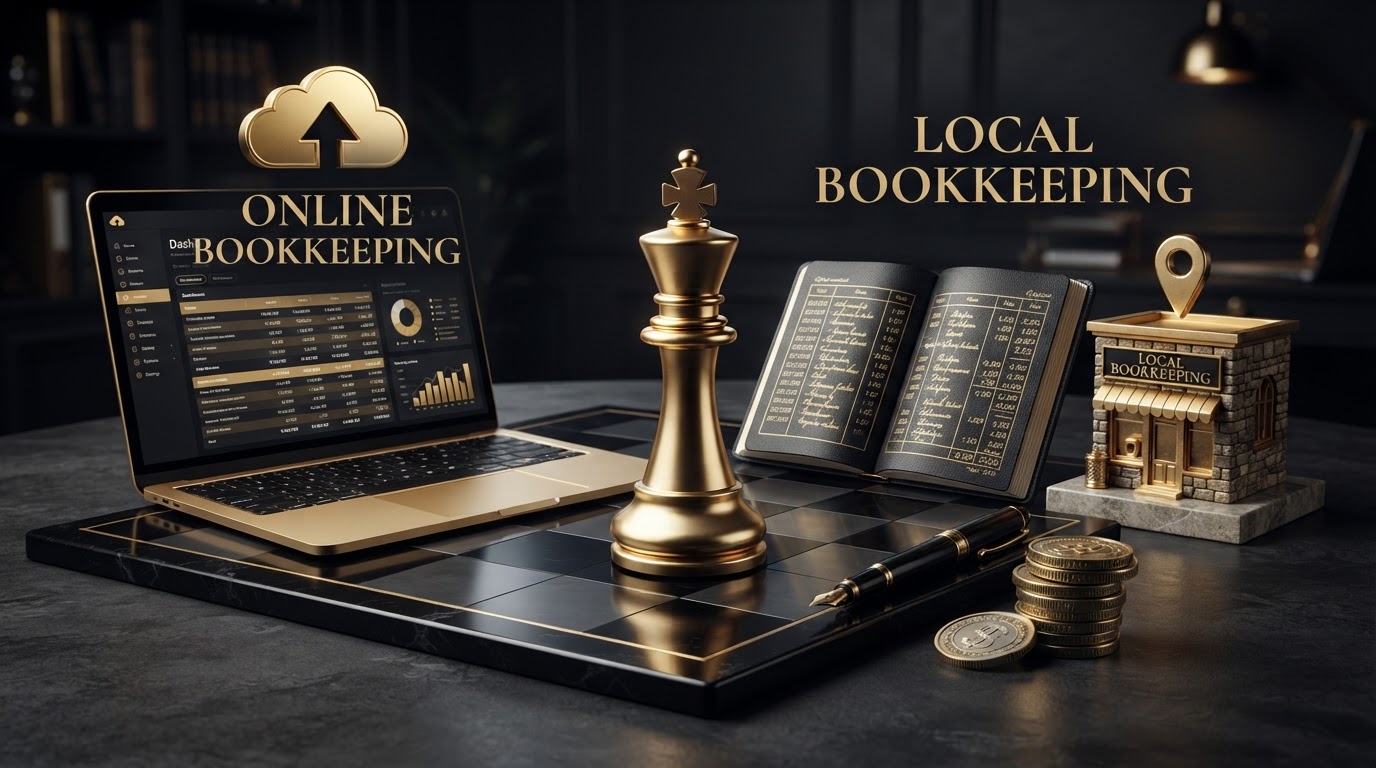
Choosing between online bookkeeping services and local bookkeepers is one of the first decisions a small business owner faces when outsourcing bookkeeping. Both options can keep your books accurate, reconciled, and organized. The difference is in how you work together, how you share records, and how the relationship fits your daily operations.
This guide compares online bookkeeping services and local bookkeepers so you can choose the right fit for your business. If you are still deciding whether to outsource at all, it helps to start with our guide on DIY bookkeeping vs. professional bookkeeping services first.
What Online Bookkeeping Services Include
Online bookkeeping services handle your books remotely through cloud accounting software. You share access to your bank and credit card accounts through secure read only connections, upload receipts and documents through a secure portal, and receive your monthly reports electronically. Communication happens through email, phone, or video calls rather than in person meetings.
The core work is the same as any bookkeeper. Online services record your transactions, reconcile your bank and credit card accounts, categorize your expenses, and prepare your monthly financial statements. The difference is the delivery method, not the bookkeeping itself. For a deeper look at what that relationship involves, see our guide on what to expect when hiring an outsourced bookkeeper.
What Local Bookkeepers Offer
Local bookkeepers work with you in person or on site. Some pick up your receipts and statements physically, enter them into your accounting software, and drop off your reports. Others work from their own office but prefer face to face meetings and paper records. The appeal is a personal relationship with someone who knows your business and your community.
Local bookkeepers handle the same core work: recording transactions, reconciling accounts, categorizing expenses, and preparing financial statements. The difference is that you meet in person, share physical documents, and build a relationship that goes beyond email. For help evaluating any bookkeeper, see our guide on questions to ask before hiring a bookkeeping service.
Key Differences Between Online and Local Bookkeeping
The practical differences between online and local bookkeeping fall into a few categories. Understanding them helps you match the option to how your business actually runs.
| Category | Online bookkeeping | Local bookkeeper |
|---|---|---|
| How you share records | Cloud software and secure portals. | Paper receipts and in person drop off. |
| Communication | Email, phone, and video calls. | Face to face meetings and phone calls. |
| Access to accounts | Read only bank and card connections. | Physical statements or shared login. |
| Report delivery | Electronic reports through your portal. | Printed reports or in person review. |
| Location | Anywhere with internet access. | Limited to your local area. |
| Scalability | Scales as your business grows. | Limited by one person capacity. |
Example: A Retail Business Choosing Online Bookkeeping
Consider a retail business with two locations and a growing online store. The owner processes sales through a point of sale system that syncs with cloud accounting software. Bank and credit card transactions flow in automatically. The owner does not want to drive receipts to a bookkeeper or schedule weekly in person meetings.
Online bookkeeping fits because the records are already digital. The bookkeeper connects to the accounting software through read only access, reconciles the bank and credit card accounts each month, and delivers reports through a secure portal. The owner reviews the reports on their own schedule and asks questions by email. The arrangement works because the business runs on cloud tools and the owner values flexibility over face to face meetings.
When Online Bookkeeping Makes Sense
Online bookkeeping makes sense when your business already runs on cloud accounting software, your bank and credit card accounts support read only connections, and you prefer electronic communication. It also works well when your business has multiple locations, remote staff, or operates across state lines. If you are comfortable reviewing reports on a screen and asking questions by email or phone, online bookkeeping gives you accurate books without the constraint of geography.
Online services also scale more easily. As your business grows and your transaction volume increases, an online bookkeeping team can absorb the added work without you needing to find a new local bookkeeper. The tradeoff is that you lose the in person relationship, which some owners value for trust and accountability.
When Local Bookkeeping Makes Sense
Local bookkeeping makes sense when you prefer face to face meetings, your records are largely paper based, or you value a personal relationship with someone who knows your business and your community. Some owners simply trust a bookkeeper they can sit across from more than one they only know through email. That comfort has real value.
Local bookkeeping also works when your business operates in one place and your records stay physical. If you hand a folder of receipts to your bookkeeper each month and pick up your reports in person, that workflow may be simpler than scanning and uploading everything. For a sense of where we work with clients locally, see our service areas page.
Example: A Service Business Choosing Local Bookkeeping
Take a service business with one office and a handful of employees. The owner has a paper filing system for receipts and invoices and prefers to sit down with a bookkeeper each month to review the numbers. The owner has used the same local bookkeeper for years and values the trust built through regular meetings.
Local bookkeeping fits because the owner wants a personal relationship and the records are physical. The bookkeeper picks up the receipt folder, enters the transactions, reconciles the accounts, and drops off printed reports. The owner reviews them together and asks questions in person. The arrangement works because the business is local, the records are paper, and the owner values the in person relationship.
Printable Bookkeeping Choice Checklist
Use this checklist to compare online and local bookkeeping for your business. Print it, save it, or bring it to your consultation so you cover every category.
- Confirm whether your accounting software is cloud based or desktop based.
- Check whether your bank and credit card accounts support read only connections.
- List how you currently store receipts and documents, paper or digital.
- Note how you prefer to communicate, in person, phone, email, or video.
- Identify whether your business has one location or multiple locations.
- Consider whether you have remote staff or employees in different states.
- Decide whether you value a personal in person relationship or flexibility more.
- Review what monthly deliverables you expect, such as reports and reconciliation.
- Check whether you want reports delivered electronically or printed.
- Consider whether your transaction volume is growing and may need to scale.
- List any industry specific bookkeeping needs your business requires.
- Note whether you want bookkeeping and payroll handled by the same provider.
- Identify your preferred response time for questions and issues.
- Confirm whether the bookkeeper also handles payroll or only bookkeeping.
- Decide which option fits your business workflow and schedule best.
Common Mistakes When Choosing a Bookkeeper
- Choosing based on method instead of fit. Online and local are delivery methods, not quality indicators. A great online bookkeeper and a great local bookkeeper both keep your books accurate. Choose based on how your business runs, not on assumptions about which is better.
- Ignoring how you share records. If your records are paper and your bookkeeper is online, you will spend time scanning and uploading. If your records are digital and your bookkeeper prefers paper, you will print everything. Match the method to your records.
- Not asking about deliverables. Whether online or local, ask what reports you receive each month and when. A bookkeeper who delivers a profit and loss statement, a balance sheet, and a reconciliation summary on a predictable schedule is more valuable than one who sends reports irregularly.
- Overlooking communication style. If you need quick answers by email and your bookkeeper prefers monthly in person meetings, the relationship will frustrate you. Confirm how you will communicate and what response time to expect before you start.
- Expecting tax preparation from a bookkeeper. A bookkeeper keeps your books accurate and organized, whether online or local. They do not prepare income tax returns, offer tax planning, or perform audits. Understand the boundary so your expectations match the service.
- Not planning for growth. If your business is growing, consider whether your bookkeeper can scale with you. A single local bookkeeper may hit capacity, while an online service may have a team that absorbs growth. Think about where your business will be next year, not just today.
Getting Started
The right bookkeeping option is the one that fits how your business runs. Whether you prefer the flexibility of online services or the personal relationship of a local bookkeeper, the goal is the same: accurate books that you can use to run your business. If you are weighing your options, the best next step is a conversation about your business and your records.
Want help comparing your bookkeeping options? Explore our bookkeeping services and let us walk through your records, your workflow, and what you need each month. We handle bookkeeping and payroll. We do not prepare income tax returns, offer tax planning, or perform audits, but we keep your books accurate and organized so you can run your business and your tax preparer or auditor can do their part efficiently.
Frequently Asked Questions
What is the main difference between online and local bookkeeping?
The main difference is how you work with your bookkeeper. Online bookkeeping services handle your books remotely through cloud accounting software and secure document sharing. Local bookkeepers work with you in person or on site, often with paper records and face to face meetings. Both can keep your books accurate. The right choice depends on how you prefer to communicate and how your business operates.
Is online bookkeeping safe for my small business?
Yes, when you work with a bookkeeper who follows secure access practices. Online bookkeepers use read only access to your bank and credit card accounts, share documents through secure portals, and store your data with encryption. Ask how your bookkeeper stores your information and who has access to it. A reputable online bookkeeper will have clear answers about security and will not ask for more access than they need.
Can a local bookkeeper handle remote or cloud accounting software?
Many local bookkeepers also work with cloud accounting software, so the line between online and local is not always clean. Some local bookkeepers prefer paper records and in person meetings, while others use the same cloud tools as online services. The question to ask is how they prefer to receive your records and communicate with you, and whether that matches how your business runs.
Do online bookkeeping services cost less than local bookkeepers?
Cost depends on the scope of work, not just the delivery method. Some online services charge less because they have lower overhead, and some local bookkeepers charge less because they have smaller operations. The more useful question is what each option includes for the price, such as monthly reconciliation, financial reporting, and communication. Compare deliverables, not just the method.
Can I switch from a local bookkeeper to an online bookkeeping service?
Yes. Switching involves transferring your accounting software, bank and credit card access, and historical records to your new bookkeeper. Expect an onboarding phase where your new bookkeeper reviews your chart of accounts, checks prior months for accuracy, and runs a first close with you. The smoother your records are at the start, the faster the switch goes.
Can Chess Bookkeeping & Payroll handle my bookkeeping online or locally?
Yes. We handle bookkeeping and payroll for small businesses through remote services, and we serve businesses in Rancho Cucamonga, the Inland Empire, California, and nationwide. We do not prepare income tax returns, offer tax planning, or perform audits, but we keep your books accurate and organized so you can run your business and your tax preparer or auditor can do their part efficiently.
Need help getting your books in order?
We focus exclusively on bookkeeping and payroll. Let's talk about where your books stand today.
Get StartedReady to simplify your books and payroll?
Schedule a consultation and let's talk about how precise bookkeeping and reliable payroll can give your business the clarity it deserves.