
How to Track Fixed Assets in Bookkeeping
A fixed asset is a big purchase your business keeps and uses for years, and it belongs on your balance sheet, not in your monthly expenses. This step by step guide walks through how to track fixed assets in bookkeeping, with real examples and a printable checklist.
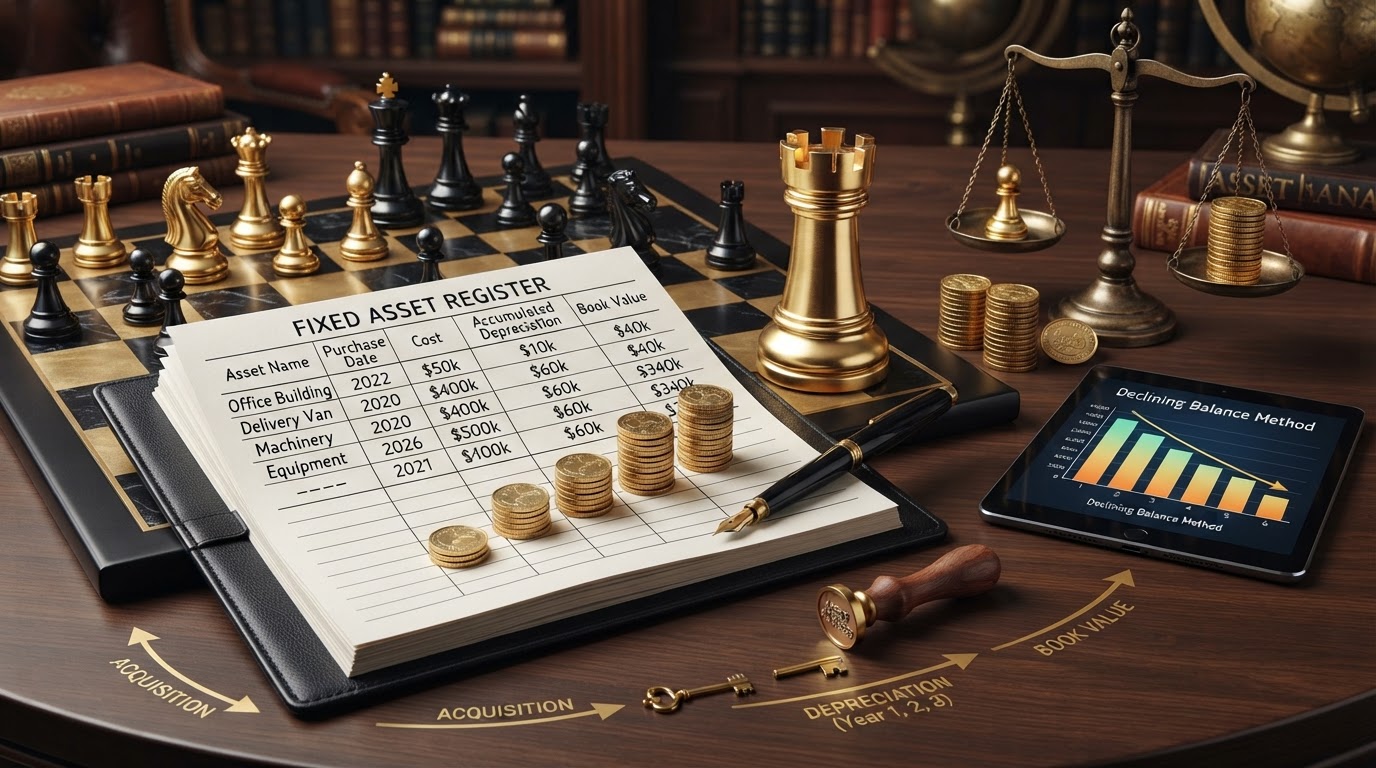
A fixed asset is a big purchase your business keeps and uses for years, not something it buys and sells. A delivery truck, a commercial oven, a piece of manufacturing equipment, a buildout of your office, or the computers your team works on are all fixed assets when they meet a cost and a useful life threshold your books recognize. Fixed assets are different from everyday expenses because they do not disappear the month you buy them. They sit on your balance sheet, lose value over time, and keep working for your business long after the purchase is made. Tracking them correctly is what keeps your balance sheet honest, your expenses clean, and your reports telling the truth about what your business owns.
This guide walks through how to track fixed assets in bookkeeping step by step. It is written for small business owners who own equipment, vehicles, or property and want to understand how those purchases flow through their books, and for bookkeepers who need a consistent routine for adding, depreciating, and retiring assets. If you are still setting up the accounts that make asset tracking possible, see our guide on what a chart of accounts is and why it matters before you build a fixed asset routine on top of it.
How to Track Fixed Assets in Bookkeeping
Tracking fixed assets is a methodical process, not a year end scramble. Work through these steps in order, one asset and one account at a time, until every fixed asset is recorded at its true cost, every depreciation entry is on schedule, and your register matches your balance sheet to the dollar.
1. Identify Which Purchases Are Fixed Assets
Not every purchase belongs in your fixed asset register. A fixed asset is a tangible item your business owns, uses in its operations, and expects to keep for more than one year. A delivery truck, a commercial refrigerator, a CNC machine, office furniture, and a leased buildout are all fixed assets. A box of printer paper, a month of software, and a tank of gas are not. The distinction matters because a fixed asset goes on your balance sheet and depreciates over time, while an everyday expense goes straight to your profit and loss the month you buy it. Apply a consistent cost threshold, such as a minimum dollar amount, so you treat a two thousand dollar laptop the same way every time and a twenty dollar stapler the same way every time.
Why it matters. A clear definition keeps your fixed asset register clean and your expenses accurate. Without it, every large purchase becomes a judgment call, and your books treat the same kind of purchase differently each month.
Common mistake. Recording every expensive purchase as a fixed asset. A large but short lived purchase belongs in your expenses, and putting it on your balance sheet overstates your assets and understates your expenses.
2. Set Up a Fixed Asset Account in Your Chart of Accounts
Create a dedicated fixed asset account in your chart of accounts, separate from your expense accounts and your cash accounts. A fixed asset account is where the original cost of an asset lives on your balance sheet, and it is the home for every asset you add to your register. Group similar assets together, such as Equipment, Vehicles, or Furniture and Fixtures, so your balance sheet shows the categories your business actually owns. The asset cost is not an expense when you buy it. It is a balance sheet item that you depreciate over its useful life, and it belongs in a fixed asset account that tracks that cost until the asset is sold, scrapped, or fully depreciated.
Why it matters. A dedicated fixed asset account keeps the cost of long lived items on your balance sheet where it belongs. Without it, your asset cost lands in an expense account and your balance sheet understates what your business owns.
Common mistake. Recording a fixed asset purchase as an expense the month you buy it. Your profit and loss takes a large hit for the month, and your balance sheet never shows the asset you still own and use.
3. Record the Asset at Its Original Cost
When you buy a fixed asset, record it at its original cost, which includes the purchase price plus any cost required to get the asset ready for use. Sales tax, delivery, installation, setup, and testing are all part of the asset cost when they are required to put the asset into service. The asset cost increases your fixed asset account, and the payment reduces your cash or increases your loan liability if you financed it. Recording the full cost up front is what makes your depreciation accurate later, because depreciation is calculated as a percentage of the cost you recorded. Leave out the installation cost and your depreciation is understated for the entire life of the asset.
Why it matters. Recording the full cost up front makes your depreciation accurate for the life of the asset. Every cost you leave out makes your depreciation understated every month until the asset is fully depreciated.
Common mistake. Recording only the sticker price and leaving out delivery and installation. Your asset cost is understated, and your depreciation is understated every month for years.
4. Maintain a Fixed Asset Register
Keep a fixed asset register, which is a list of every asset your business owns with the details that matter for bookkeeping. For each asset, record a description, the purchase date, the original cost, the useful life, the depreciation method, the accumulated depreciation to date, and the current book value. A register can live in a spreadsheet, in your accounting software, or in a dedicated fixed asset module. The format matters less than the discipline of keeping it current. A register is what turns a pile of asset purchases into a record you can reconcile, review, and hand off. Without one, your fixed assets are a balance on your balance sheet with no detail behind it.
Why it matters. A register is the detail behind your fixed asset balance. Without it, you cannot answer what you own, what it cost, how much it has depreciated, or what it is worth right now.
Common mistake. Recording the asset cost on the balance sheet but keeping no register. By year end, you have a fixed asset balance with no way to explain what it is made of.
5. Assign Each Asset a Useful Life
Assign each fixed asset a useful life, which is the number of years you expect to use it in your business before it wears out or becomes obsolete. Useful life is the basis for depreciation, and it drives how fast the asset cost moves from your balance sheet to your profit and loss. A laptop might have a useful life of three years, a delivery truck five years, and a commercial oven ten years. Apply a consistent life to each category of asset so the same kind of equipment depreciates the same way every time. The life you assign should reflect how long the asset actually serves your business, not how long you hope it lasts.
Why it matters. Useful life sets the pace of depreciation. A life that is too long understates your monthly expense, and a life that is too short overstates it, and both distort your profit.
Common mistake. Using one useful life for every asset regardless of type. A three year life on a ten year oven understates your depreciation expense for most of the asset life.
6. Choose a Depreciation Method
Choose a depreciation method and apply it consistently to each asset or asset category. Straight line depreciation spreads the cost evenly over the useful life, so a thirty thousand dollar truck with a five year life depreciates six thousand dollars a year. Accelerated methods depreciate more in the early years and less later, which can match how equipment actually loses value. Most small businesses use straight line for its simplicity and consistency, and it is the easiest method to explain and review. The method matters less than applying it consistently, because switching methods midstream makes your depreciation hard to follow and your comparisons unreliable.
Why it matters. A consistent method makes your depreciation predictable and your comparisons reliable. Switching methods without a reason makes your monthly expense jump and your trend analysis meaningless.
Common mistake. Switching depreciation methods every year because it feels right. Your expense bounces around, and you cannot tell whether your costs are rising or your method is just changing.
7. Set Up an Accumulated Depreciation Account
Set up a separate accumulated depreciation account in your chart of accounts, paired with your fixed asset account. Accumulated depreciation is the running total of all the depreciation you have recorded for an asset since you bought it, and it is a contra asset, which means it reduces the value of your fixed assets on your balance sheet. Your fixed asset account shows the original cost, your accumulated depreciation account shows how much of that cost has been expensed, and the difference is your book value. Keeping depreciation in its own account is what lets you see the original cost, the depreciation to date, and the current value all at once.
Why it matters. A separate accumulated depreciation account shows your cost, your depreciation, and your book value at a glance. Without it, your balance sheet shows only a net number and you lose the detail behind it.
Common mistake. Reducing the fixed asset account directly when you depreciate. Your balance sheet shows a shrinking asset cost, and you can no longer tell what the asset originally cost or how much it has depreciated.
8. Record Depreciation Every Month
Record depreciation expense every month, not once a year at year end. Monthly depreciation is the portion of the asset cost that belongs to that month, and recording it monthly keeps your profit and loss accurate all year and your book value current at all times. A monthly entry increases your depreciation expense and increases your accumulated depreciation by the same amount. Recording depreciation monthly also keeps your balance sheet honest every month, not just at year end, which matters when you review your statements or hand your books off. A year end catch up leaves your monthly statements understated for eleven months and overstated for one.
Why it matters. Monthly depreciation keeps your profit and loss and your balance sheet accurate all year. A year end catch up distorts every monthly statement until the day you record it.
Common mistake. Skipping monthly depreciation and recording it all at year end. Your monthly profit is overstated for eleven months, and your December expense takes a hit that makes that month look worse than it was.
9. Track the Book Value of Each Asset
Track the book value of each fixed asset, which is the original cost minus the accumulated depreciation. Book value is what your asset is worth on your books right now, and it is the number that tells you how much of the asset cost is still on your balance sheet. Update the book value every time you record depreciation, and review it alongside your balance sheet every month. A declining book value is normal and expected, and it shows the asset is being expensed over its useful life as intended. A book value that stops declining means your depreciation stopped, and a book value that is higher than your cost means something was recorded backward.
Why it matters. Book value shows what your asset is worth on your books today. Without tracking it, you lose sight of how much of the asset cost is still sitting on your balance sheet.
Common mistake. Recording depreciation but never checking the book value. A stopped depreciation entry can sit unnoticed for months, and your balance sheet carries an asset at a value that is too high.
10. Reconcile the Register to the Balance Sheet
Every month, reconcile your fixed asset register to the fixed asset balance on your balance sheet. Confirm that the total cost in your register matches the balance in your fixed asset account, and that the total accumulated depreciation matches your accumulated depreciation account. Reconciliation is what proves your register and your books agree, and it is what catches an asset you added to the register but never recorded on the books, or a depreciation entry that posted to the wrong account. A monthly reconciliation keeps your asset records trustworthy all year. For a full walkthrough of the reconciliation process, see our guide on how to reconcile a business bank account.
Why it matters. Reconciliation proves your register and your balance sheet agree. Without it, an asset can sit in your register but not on your books, and your balance sheet understates what you own.
Common mistake. Adding assets to the register but never confirming the total matches the balance sheet. Your register and your books drift apart, and nobody notices until year end.
11. Handle Asset Improvements Versus Repairs
Distinguish between an improvement and a repair when you spend money on an existing asset. A repair keeps the asset in working order and is an expense the month you pay for it. An improvement extends the life, increases the value, or adapts the asset for a new use, and it is capitalized, which means it is added to the asset cost and depreciated over time. A new engine for a delivery truck is an improvement. An oil change is a repair. The distinction matters because capitalizing a repair overstates your assets and understates your expenses, and expensing an improvement understates your assets and overstates your expenses for the month. Apply a consistent rule so similar work is treated the same way every time.
Why it matters. The line between a repair and an improvement drives where the cost goes. Treating them the same way every time keeps your balance sheet and your expenses both accurate.
Common mistake. Expensing every maintenance bill because it is easier. A major improvement disappears from your balance sheet, and your profit takes a hit the month you paid for work that benefits you for years.
12. Record the Disposal or Sale of an Asset
When you sell, scrap, or retire a fixed asset, record the disposal to remove the asset from your books. Remove the original cost from your fixed asset account, remove the accumulated depreciation from your accumulated depreciation account, and record any cash you received from the sale. The difference between the book value and the sale proceeds is a gain or loss on disposal, which goes to your profit and loss. Recording the disposal is what keeps your register and your balance sheet showing only the assets you actually still own. An asset you sold but never removed from your books sits on your balance sheet at a value that no longer exists, and your register shows equipment you no longer have.
Why it matters. A disposal entry keeps your books showing only what you still own. Without it, your balance sheet carries assets you sold, and your register lists equipment you no longer have.
Common mistake. Selling a truck and recording the cash but never removing the asset. Your balance sheet still shows the truck, your depreciation keeps running, and your books no longer match your actual equipment.
13. Review the Register at Month End
At the end of every month, review your fixed asset register alongside your balance sheet. Confirm that every asset you added this month is in the register and on the books, that depreciation recorded for the month is correct, and that the book values are declining as expected. A month end review catches an asset you bought but never recorded, a depreciation entry that stopped, or a disposal that was not completed. A fixed asset error caught in the month it happens is one entry to fix. The same error caught at year end is a register full of assets to untangle, and the longer it sits the harder it is to trace back to the month it started.
Why it matters. A month end review catches asset errors while they are one month old. Waiting until year end means untangling a full register to find which asset, which month, and which entry went wrong.
Common mistake. Skipping the month end asset review because the balance looks close enough. A missing asset or a stopped depreciation entry compounds quietly until year end, when it is far harder to trace.
14. Prepare Fixed Asset Records for Year End and Handoff
At year end, confirm that your fixed asset register matches your balance sheet, that every asset you own is recorded, that every disposal was completed, and that your depreciation for the year is complete and accurate. A clean fixed asset record at year end is what your accountant needs to prepare your financials, and it is what keeps your balance sheet honest going into the new year. Gather your asset register, your purchase receipts, your disposal records, and your depreciation schedule in one place so they are ready to hand off. For a full walkthrough of the year end process, see our guide on how to prepare your books for year end.
Why it matters. A clean year end asset record keeps your balance sheet accurate and your handoff smooth. A messy register at year end means your accountant starts the new year with assets that do not match your books.
Common mistake. Closing the year without confirming the register matches the balance sheet. A year end discrepancy carries into the new year and compounds with every asset you add or depreciate afterward.
Two Real Small Business Examples
Example: A small landscaping company. A landscaping owner bought a thirty thousand dollar truck and recorded the entire purchase as an expense the month he bought it. His profit and loss took a thirty thousand dollar hit for the month, and his balance sheet never showed the truck at all. His monthly profit swung wildly depending on which month he bought equipment, and his balance sheet understated what his business owned. When he set up a fixed asset account, moved the truck cost to his balance sheet, and depreciated it over five years, his monthly profit smoothed out, his balance sheet showed the truck he still owned, and his depreciation expense reflected the cost of using the truck every month.
Example: A growing consulting firm. A consulting firm owner bought new computers and office furniture for a growing team but kept no fixed asset register. A year later, her balance sheet showed a fixed asset balance with no detail behind it, and she could not say which computers she still owned or which ones she had replaced. She built a register with a description, purchase date, cost, and useful life for each asset, and she started reconciling it to her balance sheet every month. When she replaced a laptop, she recorded the disposal, removed the old asset, and her books finally showed only the equipment she actually still used.
Printable Fixed Asset Tracking Checklist
Use this checklist to track your fixed assets every month. Print it, save it, or share it with whoever handles your books.
- Identify which purchases are fixed assets using a consistent cost and useful life threshold.
- Set up a dedicated fixed asset account in your chart of accounts.
- Record each asset at its original cost, including delivery, installation, and setup.
- Maintain a fixed asset register with description, date, cost, life, method, and book value.
- Assign each asset a useful life that reflects how long it serves your business.
- Choose a depreciation method and apply it consistently to each asset category.
- Set up a separate accumulated depreciation account paired with your fixed asset account.
- Record depreciation expense every month, not just at year end.
- Track the book value of each asset and review it alongside your balance sheet.
- Reconcile your fixed asset register to your balance sheet every month.
- Distinguish between asset improvements, which are capitalized, and repairs, which are expensed.
- Record the disposal or sale of an asset to remove it from your books.
- Review your fixed asset register at month end and confirm every entry is correct.
- Confirm your fixed asset records are complete and accurate before year end handoff.
Getting Started
Tracking fixed assets is the difference between a balance sheet that shows what your business actually owns and one that quietly understates your equipment, overstates your monthly profit, or carries assets you sold months ago. Every asset you record at its true cost, every month you depreciate it, and every disposal you complete keeps your books accurate and your reports trustworthy. The routine is the same every month: identify the asset, record the cost, depreciate it on schedule, reconcile the register, and review it at month end. Build it into a habit and the work stays manageable. Skip it and your balance sheet drifts, your depreciation falls behind, and your register stops matching your books. If your fixed asset records are behind or your balance sheet does not reflect what you own, the best next step is a conversation about where your books stand today.
Ready to get your fixed assets tracked accurately? Explore our bookkeeping services and let us set up your fixed asset accounts, maintain your register, record your depreciation every month, and reconcile your asset balances to your balance sheet. We handle bookkeeping and payroll. We do not prepare income tax returns, offer tax planning, or perform audits, but we keep your books accurate and your balance sheet honest so you can run your business with confidence.
Frequently Asked Questions
What is a fixed asset in bookkeeping?
A fixed asset is a tangible item your business owns, uses in its operations, and expects to keep for more than one year. Examples include vehicles, equipment, furniture, and machinery. Fixed assets are recorded on your balance sheet at their original cost and depreciated over their useful life, rather than expensed entirely in the month you buy them. This treatment matches the cost of the asset to the years it actually serves your business.
Why is my equipment purchase not recorded as an expense?
A fixed asset is a long lived item that benefits your business for years, so its cost is spread over its useful life through depreciation rather than recorded as a single expense in the month you buy it. Recording the entire cost as an expense in one month distorts your profit for that month and understates what your business owns on your balance sheet. Depreciation moves a portion of the cost to your profit and loss each month, which keeps both your monthly profit and your balance sheet accurate.
What is the difference between book value and market value?
Book value is the original cost of your asset minus the accumulated depreciation recorded in your books. It is an accounting number that shows what the asset is worth on your balance sheet right now. Market value is what the asset would actually sell for today. Book value declines steadily as you depreciate the asset, while market value depends on condition, demand, and the used market. Your books track book value, not market value, because book value is based on the cost you recorded and the depreciation you applied.
How do I know how long to depreciate an asset?
Assign each asset a useful life that reflects how long you expect to use it in your business before it wears out or becomes obsolete. A laptop might have a three year life, a delivery truck five years, and a commercial oven ten years. Apply a consistent life to each category of asset so similar equipment depreciates the same way every time. The life you set drives the pace of depreciation, so a life that is too long understates your monthly expense and a life that is too short overstates it.
What happens when I sell or scrap a fixed asset?
Record a disposal entry to remove the asset from your books. Remove the original cost from your fixed asset account, remove the accumulated depreciation from your accumulated depreciation account, and record any cash you received from the sale. The difference between the book value and the sale proceeds is a gain or loss on disposal, which goes to your profit and loss. Recording the disposal keeps your register and your balance sheet showing only the assets you still own.
Should I capitalize an improvement or expense a repair?
A repair keeps an asset in working order and is an expense the month you pay for it. An improvement extends the life, increases the value, or adapts the asset for a new use, and it is capitalized, which means it is added to the asset cost and depreciated over time. An oil change is a repair. A new engine is an improvement. Apply a consistent rule so similar work is treated the same way every time, because capitalizing a repair overstates your assets and expensing an improvement understates them.
Can Chess Bookkeeping & Payroll help me track my fixed assets?
Yes. Tracking fixed assets is a core part of our bookkeeping service. We set up your fixed asset and accumulated depreciation accounts, record each asset at its original cost, maintain your fixed asset register, record depreciation every month, reconcile your register to your balance sheet, and record disposals when you sell or retire equipment. We handle bookkeeping and payroll. We do not prepare income tax returns, offer tax planning, or perform audits, but we keep your asset records accurate and your balance sheet honest so you can make confident decisions.
Need help getting your books in order?
We focus exclusively on bookkeeping and payroll. Let's talk about where your books stand today.
Get StartedReady to simplify your books and payroll?
Schedule a consultation and let's talk about how precise bookkeeping and reliable payroll can give your business the clarity it deserves.