
How to Record Business Loan Payments in Your Books
A business loan payment splits into principal and interest, and each part belongs in a different place in your books. This step by step guide walks through how to record business loan payments correctly, with real examples and a printable checklist.
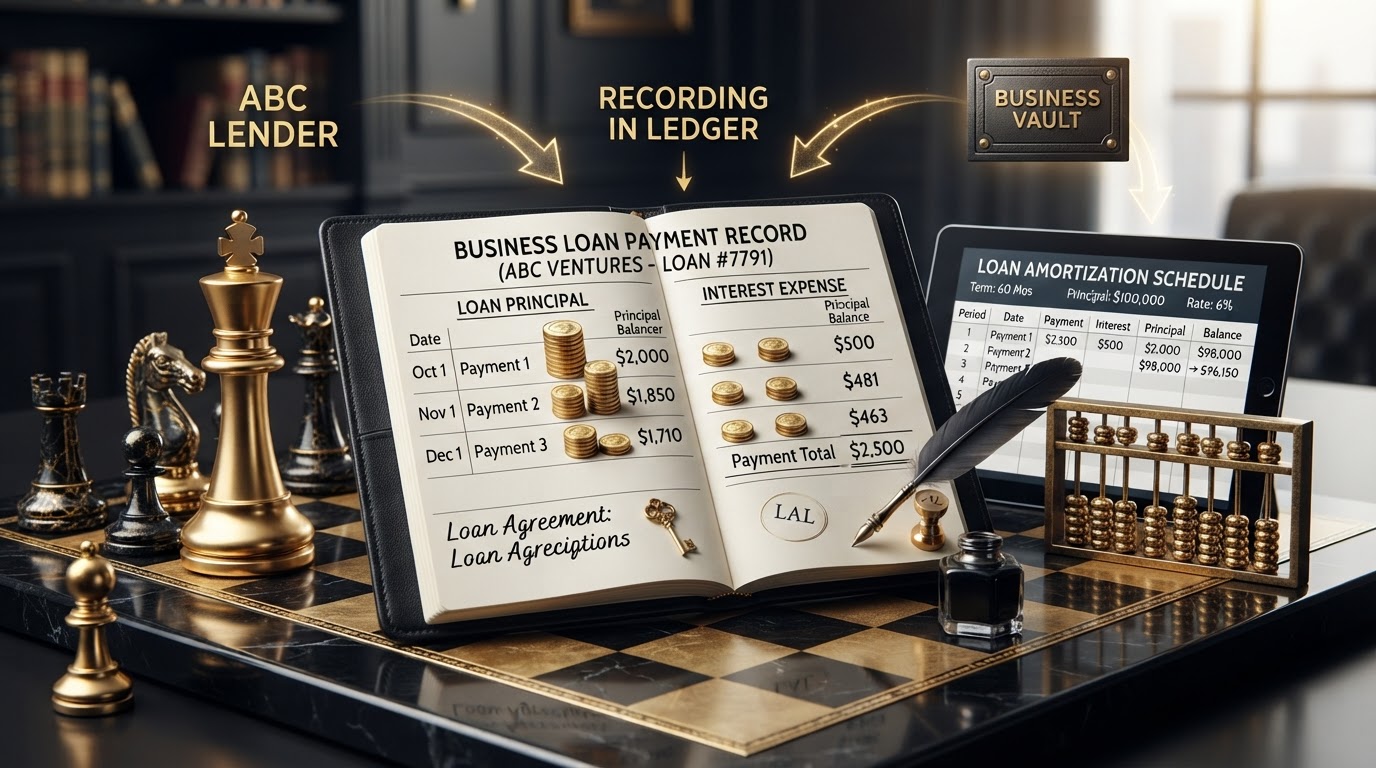
A business loan is not a single transaction. It is a series of payments that stretch over months or years, and every payment splits into two parts that belong in two different places in your books. One part pays down the principal, which is the money you borrowed. The other part pays the interest, which is the cost of borrowing it. Recording those two parts correctly is what keeps your loan balance accurate, your interest expense clean, and your balance sheet telling the truth about what your business owes. Record a loan payment wrong and your loan balance drifts, your expenses mislead you, and your reports stop matching the lender statement that arrives every month.
This guide walks through how to record business loan payments in your books step by step. It is written for small business owners who carry a loan and want to understand their own books, and for bookkeepers who need a consistent routine to follow every month. If you are still setting up the accounts that make loan tracking possible, see our guide on what a chart of accounts is and why it matters before you build a loan tracking routine on top of it.
How to Record Business Loan Payments in Your Books
Recording business loan payments is a methodical process, not a year end scramble. Work through these steps in order, one payment and one account at a time, until every loan payment is split correctly, every balance is reconciled, and your books match your lender statement to the dollar.
1. Set Up a Dedicated Loan Liability Account
Before you record a single loan payment, set up a dedicated liability account in your chart of accounts for the loan principal. A liability account is where money you owe lives in your books, separate from the money you earn and spend. Name it clearly after the lender or the loan, such as Equipment Loan Payable or Line of Credit Payable, so you can tell your loans apart at a glance. The loan principal is not income and it is not an expense. It is a liability you owe, and it belongs in a liability account that tracks the balance you still have to pay down over the life of the loan.
Why it matters. A dedicated liability account keeps your loan balance separate from your operating accounts. Without it, your loan principal gets buried in a generic account and your balance sheet stops showing what you actually owe.
Common mistake. Recording the loan principal as revenue. Money you borrow is not income, and recording it as revenue makes the business look more profitable than it really is.
2. Record the Loan Proceeds When the Money Arrives
When the loan funds hit your bank account, record the full loan amount in your books. The cash you received increases your bank account, and the same amount increases your loan liability account. This is the entry that puts the loan on your books at its true starting balance. Recording the loan proceeds the day they arrive keeps your bank balance accurate and your loan liability correct from the first day. A loan recorded late shows up as a mystery deposit with no matching liability, and your balance sheet understates what you owe until you catch it.
Why it matters. Recording the loan proceeds when they arrive keeps your bank balance and your loan liability accurate from the start. Waiting leaves a mystery deposit with no matching liability on your balance sheet.
Common mistake. Depositing the loan proceeds and assuming you will sort it out later. By month end, the deposit is a line on a statement with no context, and your loan balance is understated.
3. Set Up a Separate Interest Expense Account
Create a separate expense account in your chart of accounts for loan interest, distinct from your loan liability account. Interest is the cost of borrowing money, and it is a real business expense that belongs in your profit and loss statement. Keeping interest in its own account is what lets you see exactly what borrowing costs you each month, separate from the principal you are paying down. Mixing interest into the loan liability account hides your borrowing cost, and mixing it into a generic expense account makes it impossible to separate from your other operating expenses.
Why it matters. A separate interest expense account shows your true cost of borrowing each month. Without it, your interest cost is hidden inside another account and you cannot see what borrowing actually costs.
Common mistake. Recording the entire loan payment against the loan liability account. The interest portion never appears as an expense, so your profit looks higher than it really is.
4. Split Every Loan Payment Into Principal and Interest
Every loan payment splits into two parts: the principal portion, which reduces your loan liability, and the interest portion, which is your expense for the month. Pull the split from your lender statement or your loan amortization schedule, which shows exactly how much of each payment goes to principal and how much goes to interest. Record the principal portion as a reduction to your loan liability account, and record the interest portion as an increase to your interest expense account. The two parts of one payment go to two different accounts, and recording them correctly is what keeps both your balance sheet and your profit and loss accurate at the same time.
Why it matters. Splitting each payment keeps your loan balance and your interest expense both accurate. Recording the whole payment in one account makes one of the two wrong every single month.
Common mistake. Recording the entire loan payment as a single amount against the loan liability. Your loan balance drops too fast, and your interest expense disappears from your profit and loss entirely.
5. Use the Lender Amortization Schedule as Your Source
Use the amortization schedule from your lender as the source for every principal and interest split. An amortization schedule is a table that shows how each payment divides between principal and interest over the life of the loan, and it is the authoritative breakdown for every payment you record. Do not estimate the split or guess at the percentages, because the actual split changes every month as the principal balance declines. Early payments carry more interest and less principal, and later payments carry more principal and less interest. The schedule tells you the exact split for each specific payment, and using it keeps your loan balance matching the lender statement to the dollar.
Why it matters. The amortization schedule is the authoritative source for each payment split. Estimating the split makes your loan balance drift from the lender statement a little more every month.
Common mistake. Splitting every payment fifty fifty between principal and interest. The real split shifts every month, and a flat split makes your loan balance wrong from the first payment onward.
6. Record the Payment the Day It Clears the Bank
Record each loan payment in your books the day it clears your bank account, not the day you schedule it or the day you intend to make it. A payment that clears is a payment that happened, and recording it when it clears keeps your bank balance and your loan balance accurate on the same day. Recording a payment before it clears creates a mismatch between your books and your bank, and recording it weeks after it clears leaves your loan balance overstated in the meantime. Match your bookkeeping to the actual movement of cash, and your books stay trustworthy every day of the month.
Why it matters. Recording the payment when it clears keeps your books and your bank in sync. Recording it early or late creates a gap between your book balance and your real cash.
Common mistake. Recording the payment on the scheduled due date instead of the day it clears. A delay in the transfer leaves your bank balance and your loan balance out of sync for days.
7. Reconcile the Loan Account Every Month
Every month, reconcile your loan liability account against your lender statement. Confirm that the principal portion you recorded matches the principal portion the lender reports, and that your remaining loan balance matches the lender balance at the end of the month. Reconciliation is what proves your loan tracking is accurate, and it is what catches a missing payment, a wrong split, or an interest charge you forgot to record. A monthly reconciliation of your loan account keeps your balance sheet honest all year. For a full walkthrough of the reconciliation process, see our guide on how to reconcile a business bank account.
Why it matters. Reconciliation is what proves your loan balance is accurate. Without it, a wrong split or a missing payment can sit unnoticed for months.
Common mistake. Recording loan payments but never reconciling the loan account. Your balance looks right, but a wrong split or a missed payment can hide until year end.
8. Track the Declining Loan Balance Over Time
Maintain a running balance of your remaining loan principal, and review it alongside your balance sheet every month. Your loan balance declines with every principal payment, and tracking that decline shows you exactly how much you still owe and how far you are from paying the loan off. A declining loan balance is a sign of progress, and it is a number every owner with a loan should know. Update the balance every time you record a payment, and watch it drop month over month. A loan balance that is not declining means a payment was recorded wrong, and a balance that is growing means you drew on a line of credit without recording it.
Why it matters. A running loan balance shows how much you owe and how fast you are paying it down. Without it, you lose sight of your debt until the lender sends a statement.
Common mistake. Recording payments but never checking the running balance. A wrong split can make your balance decline too fast or too slow, and you would not notice without watching the trend.
9. Record Loan Fees and Closing Costs Correctly
Record any loan fees, origination costs, or closing costs your lender charged when the loan was issued. Some fees are deducted from the loan proceeds before they reach your bank, which means the cash you receive is less than the loan principal on the lender statement. Record the full loan principal as your liability, record the net cash as your bank deposit, and record the fees as an expense or as part of the loan basis depending on how your accountant advises. Fees that vanish from your books make your loan balance and your bank balance disagree from day one, and recording them correctly is what keeps both numbers trustworthy.
Why it matters. Recording fees correctly keeps your loan balance and your bank balance both accurate from the start. Ignoring them creates a gap between your books and the lender statement on day one.
Common mistake. Recording only the net cash you received as the loan principal. Your loan balance understates what you owe by the amount of the fees the lender deducted.
10. Handle Line of Credit Draws and Repayments
If your loan is a line of credit, record every draw as an increase to your loan liability and every repayment as a decrease. A line of credit is a loan with a flexible balance, and each draw and repayment changes what you owe. Record a draw the day the funds hit your bank, and record a repayment the day it clears. Unlike a term loan, a line of credit does not have a fixed amortization schedule, so you track the balance by recording every movement of cash in and out. A line of credit that is not tracked this way becomes a mystery account, and your balance sheet stops reflecting the true amount you have drawn.
Why it matters. Tracking every draw and repayment keeps your line of credit balance accurate. Without it, your balance sheet understates or overstates what you owe at any given time.
Common mistake. Treating a line of credit like a regular bank account. Draws and repayments get mixed into your operating cash, and your loan liability disappears from your balance sheet.
11. Separate the Loan Principal From Your Operating Expenses
Never record a loan principal payment as a business expense. The principal you pay down is a reduction of a liability, not a cost of running your business. Recording it as an expense inflates your expenses and makes your business look less profitable than it is, which misleads every decision you base on your profit and loss. The interest portion is your expense. The principal portion is a balance sheet transaction that moves money from your bank account to your loan liability. Keeping the two separate is what keeps your profit and loss clean and your balance sheet accurate at the same time.
Why it matters. Separating principal from expenses keeps your profit and loss clean. Recording principal as an expense makes your business look less profitable than it really is.
Common mistake. Recording the entire loan payment as an expense. Your expenses are overstated by the principal portion, and your loan balance never decreases on your balance sheet.
12. Document Every Loan Payment With Clear Notes
Write a clear note for every loan payment you record that includes the payment date, the payment amount, the principal portion, the interest portion, and the lender. A note turns a bare number into a record you can read months later. A payment recorded as one thousand two hundred dollars with no note is a mystery by year end. A payment recorded as one thousand two hundred dollars, eight hundred principal and four hundred interest, paid to First Bank on the fifteenth, is a fact you can verify and explain. Clear notes make your loan tracking auditable, and they save you hours when you reconcile or hand your books off.
Why it matters. A note turns a number into a record you can verify. Without it, a loan payment is a figure nobody can explain by year end.
Common mistake. Recording the payment amount but leaving the note blank. By year end, you face a list of payments with no breakdown, and you cannot tell principal from interest without pulling every lender statement.
13. Review the Loan Balance at Month End
At the end of every month, review your loan liability balance alongside your balance sheet and your lender statement. Confirm that your book balance matches the lender balance, that every payment for the month was recorded, and that the principal and interest splits are correct. A month end loan review catches a missing payment or a wrong split while it is still one month old, not a year old. A loan balance that drifts for months is far harder to fix than one you catch in the month it happens, because the longer it drifts the more payments you have to untangle to find the error.
Why it matters. A month end review catches loan errors while they are one month old. Waiting until year end means untangling twelve months of payments to find one mistake.
Common mistake. Skipping the month end loan review because the balance looks close enough. A small drift every month compounds into a large discrepancy by year end.
14. Prepare Loan Records for Year End and Handoff
At year end, confirm that your loan balance matches your final lender statement, that every payment for the year is recorded, and that your interest expense total is complete and accurate. A clean loan record at year end is what your accountant needs to prepare your financials, and it is what keeps your balance sheet honest going into the new year. Gather your lender statements, your amortization schedule, and your payment records in one place so they are ready to hand off. For a full walkthrough of the year end process, see our guide on how to prepare your books for year end.
Why it matters. A clean year end loan record keeps your balance sheet accurate and your handoff smooth. A messy loan record at year end means your accountant starts the new year with a wrong balance.
Common mistake. Closing the year without confirming the loan balance against the lender statement. A year end discrepancy carries into the new year and compounds with every payment that follows.
Two Real Small Business Examples
Example: A small landscaping company. A landscaping owner took out a forty thousand dollar equipment loan for a new truck and trailer. He recorded the full loan amount as revenue because the cash showed up in his bank account, and he recorded every monthly payment as a single expense. His profit and loss showed a forty thousand dollar spike in income the month the loan funded, and his expenses were inflated by the principal portion of every payment. His balance sheet never showed the loan at all. When he finally set up a loan liability account and split each payment into principal and interest, his real profit emerged, his balance sheet showed the true amount he owed, and his lender statement matched his books for the first time.
Example: A growing consulting firm. A consulting firm owner used a line of credit to cover cash flow gaps between project payments. She drew on the line several times a year and repaid it when clients paid, but she never recorded the draws or the repayments in her books. Her bank balance looked higher than her actual cash because the draws sat there unexplained, and her balance sheet showed no loan at all. She started recording every draw as an increase to her line of credit liability and every repayment as a decrease, and her balance sheet finally reflected the true amount she owed at any given time. Her cash flow became clear, and she could see exactly how much credit she was using at any point in the year.
Printable Business Loan Payment Recording Checklist
Use this checklist to record your business loan payments every month. Print it, save it, or share it with whoever handles your books.
- Set up a dedicated loan liability account in your chart of accounts.
- Set up a separate interest expense account for loan interest.
- Record the full loan proceeds as a deposit and a liability when the funds arrive.
- Split every loan payment into principal and interest using the lender amortization schedule.
- Record the principal portion as a reduction to your loan liability account.
- Record the interest portion as an increase to your interest expense account.
- Record each payment the day it clears your bank account.
- Reconcile your loan liability account against your lender statement every month.
- Track the declining loan balance and review it alongside your balance sheet.
- Record any loan fees or closing costs separately so your balances match from day one.
- Record every line of credit draw as an increase and every repayment as a decrease.
- Never record a loan principal payment as a business expense.
- Document every payment with the date, amount, principal split, interest split, and lender.
- Review your loan balance at month end and confirm it matches your lender statement.
- Confirm your loan records are complete and accurate before year end handoff.
Getting Started
Recording business loan payments correctly is the difference between a balance sheet that tells the truth about what you owe and one that quietly drifts out of sync with your lender. Every payment you split, every balance you reconcile, and every note you document keeps your books accurate and your reports trustworthy. The routine is the same every month: set up the right accounts, split each payment by the lender schedule, record it the day it clears, and reconcile the balance at month end. Build it into a habit and the work stays manageable. Skip it and your loan balance drifts, your expenses mislead you, and your balance sheet stops matching the statement that arrives every month. If your loan records are behind or your balances do not match your lender, the best next step is a conversation about where your books stand today.
Ready to get your loan records accurate and reconciled? Explore our bookkeeping services and let us set up your loan accounts, split every payment correctly, and reconcile your balances against your lender statements every month. We handle bookkeeping and payroll. We do not prepare income tax returns, offer tax planning, or perform audits, but we keep your books accurate and your balance sheet honest so you can run your business with confidence.
Frequently Asked Questions
Is a loan payment a business expense?
Only the interest portion is a business expense. The principal portion is a reduction of your loan liability, not a cost of running your business. Recording the principal as an expense inflates your expenses and makes your business look less profitable than it really is. Split every payment into the principal portion, which reduces your loan balance, and the interest portion, which is your expense for the month.
How do I know how much of each payment is principal and how much is interest?
Use the amortization schedule from your lender, which shows the exact split for every payment over the life of the loan. The split changes every month because the principal balance declines, so early payments carry more interest and later payments carry more principal. Never estimate the split or use a flat percentage, because the actual amounts shift every month and a flat split makes your loan balance drift from the lender statement.
Where does the loan principal go in my books?
The loan principal goes in a dedicated liability account, such as Loan Payable or Line of Credit Payable, on your balance sheet. When you receive the loan proceeds, the full principal increases your liability account and increases your bank account. When you make a payment, the principal portion reduces your liability account and reduces your bank account. The principal never appears in your profit and loss statement, because it is not income and it is not an expense.
Do I need a separate account for each loan?
Yes, if you have more than one loan, set up a separate liability account for each one so you can track the balances independently. Name each account clearly after the lender or the loan, such as Equipment Loan Payable or Line of Credit Payable. Separate accounts let you see exactly what you owe on each loan, reconcile each one against its own lender statement, and track the declining balance of each loan over time.
How do I record a line of credit draw?
Record a line of credit draw as an increase to your line of credit liability account and an increase to your bank account the day the funds arrive. Record a repayment as a decrease to your liability account and a decrease to your bank account the day it clears. Unlike a term loan, a line of credit does not have a fixed amortization schedule, so you track the balance by recording every draw and every repayment as they happen.
What if my loan balance does not match my lender statement?
Reconcile the loan account against the lender statement to find the discrepancy. Check for a missing payment, a wrong principal and interest split, a payment recorded on the wrong date, or a draw you forgot to record. A loan balance that drifts for months is far harder to fix than one you catch in the month it happens, so reconcile your loan account every month and resolve any difference right away.
Can Chess Bookkeeping & Payroll help me record my loan payments?
Yes. Recording business loan payments correctly is a core part of our bookkeeping service. We set up your loan liability and interest expense accounts, split every payment into principal and interest using your lender schedule, reconcile your loan balance against your lender statement every month, and keep your balance sheet accurate. We handle bookkeeping and payroll. We do not prepare income tax returns, offer tax planning, or perform audits, but we keep your books accurate and your loan balances correct so you can make confident decisions.
Need help getting your books in order?
We focus exclusively on bookkeeping and payroll. Let's talk about where your books stand today.
Get StartedReady to simplify your books and payroll?
Schedule a consultation and let's talk about how precise bookkeeping and reliable payroll can give your business the clarity it deserves.